Introduction: The Unsung Hero of Power Safety
In modern industrial production and daily life, power safety is an issue that can never be ignored. Have you ever wondered why large factories, high-rise buildings, and subway stations can operate stably for years without being affected by grid fluctuations?
Behind this stability lies an “unsung hero”—the Three-Phase Isolation Transformer.
Core Working Principle: Electromagnetic Induction & Isolation
The core of a three-phase isolation transformer lies in utilizing the principle of electromagnetic induction between the iron core and the windings to achieve voltage conversion and electrical isolation.
- The Process: When 380V three-phase AC power is connected to the primary winding, the alternating magnetic flux generated in the iron core induces the same voltage in the secondary winding.
- The Barrier: The two sets of windings are connected only by the magnetic circuit, with no direct electrical contact. This design acts like a safety barrier between the power grid and the electrical equipment, effectively blocking potential threats such as high-frequency clutter and fault currents.
Deep Dive: How Electromagnetic Isolation Works
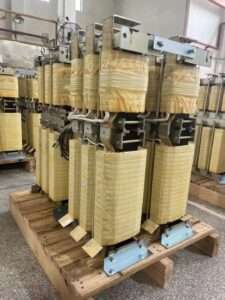
The three-phase isolation transformer adopts a structure with three independent iron core columns. Primary and secondary windings are wound on each column respectively.
- Magnetic Field: Three-phase alternating current generates a rotating magnetic field with a 120° phase difference in the iron core, transferring energy via Faraday’s Law of Induction.
- Noise Suppression: The uniqueness lies in the insulation treatment between windings. This physical isolation technology eliminates ground loop interference and suppresses common-mode noise, providing a pure power source for precision electronic equipment.
Performance Parameters and Specifications
For a standard 380V to 380V (1:1) isolation transformer:
- Voltage Stability: It maintains an output stability of ±5% within an input voltage fluctuation range of 342-418V.
- Capacity: Common capacities range from 10kVA to 30kVA. For example, a 10kVA model has a rated line current of approximately 15.2A at 380V line voltage.
- Connection Types:
- Star (Y/Y) Connection: Provides a neutral line, suitable for three-phase four-wire systems.
- Delta (△/Y) Connection: Effectively suppresses harmonics and improves power quality.
Industrial Applications and Future Trends
Three-phase isolation transformers are versatile in their application:
- Power Plants: Handling critical voltage conversion tasks.
- Industrial Control: Protecting sensitive equipment from grid interference.
- Rail Transit: Ensuring the stable operation of electric motors.
- Smart Buildings: Providing clean power for lighting and security systems.
Future Outlook: With technological advancements, new isolation transformers are moving towards high energy efficiency and intelligence. Innovations include using amorphous alloy cores to reduce no-load losses and integrating temperature sensors for real-time monitoring, perfectly meeting the needs of smart grid construction.
Conclusion
From principle to application, the three-phase isolation transformer demonstrates the enduring value of foundational power equipment. In today’s safety-conscious world, this device—combining voltage conversion, electrical isolation, and interference suppression—continues to safeguard power systems across industries.
The next time you walk into a brightly lit mall or ride a smoothly running subway, you might remember these isolation transformers hidden in the power distribution rooms. It is their silent work that makes modern electricity application so safe and reliable.